ECU coding vs ECU programming
These terms get mixed up. On modern vehicles, the difference matters because the risk profile is different. You're not working on a "box" — you're touching a network. Coding changes configuration. Programming writes software (flash). Both must be executed inside constraints: stable power, verified communication, backups, and integrity checks.
Coding, programming, diagnostics
Three different risk profiles. Knowing which applies changes how we approach the job.
What "coding" usually means
Coding is configuration. It sets the module to match the vehicle's build, options, and installed parts. Common after module replacement, retrofits, or incorrect variant stored.
What "programming" usually means
Programming is writing firmware or calibration to the module (flash). Higher risk if battery voltage drops or comms are unstable during the write.
Why diagnostics comes first
We confirm whether the ECU is actually the cause. A "dead ECU" can be CAN wiring, power supply, fuses, immobiliser mismatch, or network gateway issues.
Common cases we see
These are typical triggers for coding / programming work. Exact method depends on vehicle platform, year, module type and state.
Module replacement
ECU / TCU / BCM replaced and now the vehicle has warning lights, missing functions, or no-start due to mismatch.
Immobiliser mismatch
Key / immobiliser / ECU alignment issues after repairs, low voltage events, or unauthorized swaps.
Failed flash / corruption
Programming interrupted. Module may be in boot / recovery state or not communicating at all (case dependent).
How we access modules
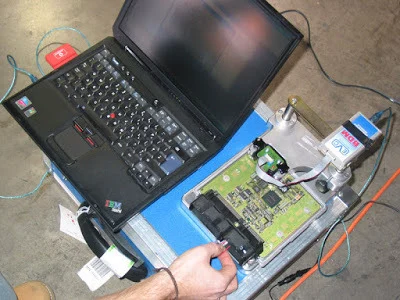
Modern diagnostics uses multiple access layers. Which one applies depends on the vehicle and module.
OBD / in-vehicle:  CAN · DoIP · K-Line
Pass-thru:         J2534 (where applicable)
Bench:             controlled power + comms, EEPROM/flash access (where supported)
Note:              capability depends on platform/module and condition
Safety sequence (fail-closed)
The goal isn't to "get it done". The goal is to not brick the module, not corrupt data, and not leave the vehicle in an undefined state. That means enforcing gates before any high-risk operation.
VOLTAGE_CHECK        real-time voltage monitoring (required)
DUAL_BACKUP          coding snapshot + ECU/EEPROM backup where supported (required)
CHECKSUM_MATCH       integrity verification before/after write (required)
USER_ACKNOWLEDGMENT  explicit confirmation on high-risk operations (required)
Mail-in workflow (what to send)
Mail-in works best when we receive full context. Missing information causes delays and incorrect assumptions.
Include in the box
Send on WhatsApp
Important
Not every ECU problem is solved by programming. Sometimes the correct fix is wiring, power, CAN bus repair, or immobiliser diagnosis. We confirm before we touch anything.
Agreements: Terms · IMMO-off agreement · DTC modification agreement